Quick answer
The main types of TMS are standard rTMS, deep TMS and theta burst stimulation; they all use magnetic pulses to stimulate the brain, but differ in coil design, pulse pattern and how long each session takes.
If you have started reading about TMS, you have probably come across a confusing mix of names: rTMS, deep TMS, theta burst, accelerated TMS. They sound alike, and clinics don’t always explain the difference. At Be Well Psychology in Calgary, we offer Exomind, which uses a technology called ExoTMS, so we hear these questions often.
This guide explains each type of TMS in plain language, compares them side by side and lists the questions worth asking before you start.
What Is TMS Therapy?
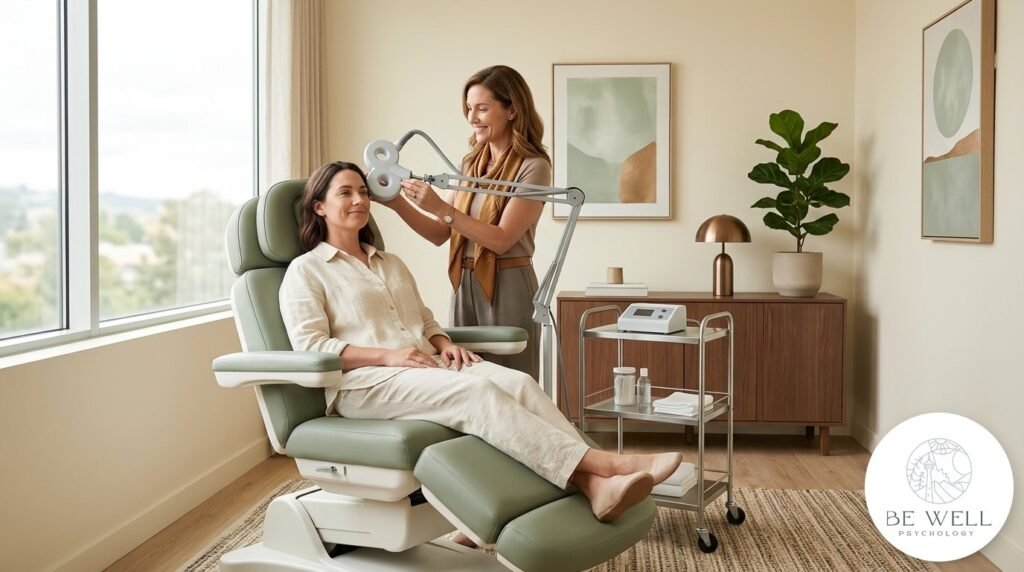
TMS, or transcranial magnetic stimulation, is a non-invasive treatment that uses magnetic pulses to stimulate specific areas of the brain.
According to the U.S. National Institute of Mental Health (NIMH), an electromagnetic coil is held against the head. The magnetic field, about as strong as an MRI scanner, switches on and off very quickly and creates weak electrical currents that stimulate nerve cells in the targeted area. Because the pulses are repeated, the treatment is called repetitive TMS, or rTMS.
TMS does not require anesthesia and can be done in a clinic or office. During the pulses, most people feel a slight knocking or tapping on the head.
Standard rTMS
Standard rTMS delivers repeated magnetic pulses through a coil placed over one targeted brain area.
For depression, NIMH explains that the coil is usually placed over the left prefrontal cortex, an area involved in mood regulation. A typical course is daily sessions, five days a week, for four to six weeks. In a large Canadian study, a standard high-frequency session took about 37 minutes.
Standard rTMS has the longest track record of the TMS types. It was approved for depression by Health Canada in 2002 and by the FDA in 2008.
Deep TMS
Deep TMS uses a different coil design to reach larger structures deeper in the brain.
NIMH notes that in deep TMS, two coils may be used to deliver more stimulation to a region and reach larger, deeper brain structures. In 2018, the FDA permitted marketing of a deep TMS system for obsessive-compulsive disorder (OCD) in people who had not responded to traditional treatments.
Session length and the number of sessions vary by device and protocol, so ask the clinic for its specific schedule.
Theta Burst Stimulation (iTBS)
Theta burst stimulation is a form of rTMS that delivers pulses in short, rapid bursts, so a session takes about three minutes instead of 37.
Intermittent theta burst stimulation (iTBS) uses a pulse pattern that mimics the brain’s natural rhythms. In a 2018 study published in The Lancet, researchers at the University of British Columbia and in Toronto treated 414 people with treatment-resistant depression five days a week for up to six weeks. They found the three-minute iTBS version was just as effective as the standard 37-minute version.
A related idea is accelerated rTMS. NIMH explains that accelerated protocols give several sessions in a single day, with short breaks in between, and often work within a week.
Where ExoTMS Fits
ExoTMS is the technology used by the Exomind device, which is licensed by Health Canada. The manufacturer says ExoTMS pulses start low and ramp up gradually rather than hitting peak power at once, an approach meant to improve comfort. Each Exomind treatment takes under 30 minutes. You can read about sessions, safety and suitability on our Exomind TMS therapy page.
Types of TMS Compared
The biggest practical differences are session length, how many sessions you need and what each type is authorized to treat.
| Type | How it differs | Session length | Typical course | Example authorization |
|---|---|---|---|---|
| Standard rTMS | Repeated pulses through a coil over one targeted area | About 37 minutes (high-frequency protocol in the Canadian study) | Daily, 5 days a week for 4–6 weeks | Depression: Health Canada (2002), FDA (2008) |
| Deep TMS | Coil design that reaches larger, deeper brain structures | Varies by device | Varies by protocol | OCD: FDA (2018) |
| Theta burst (iTBS) | Short, rapid bursts of pulses | Just over 3 minutes | 5 days a week for up to 6 weeks (in the study) | Studied in treatment-resistant depression |
| ExoTMS (Exomind) | Pulses that ramp up gradually (manufacturer) | Under 30 minutes | Set by your provider | Health Canada licensed |
| ECT (for comparison) | Electric current causes a brief seizure under anesthesia | Seizure lasts under a minute; you wake 5–10 minutes later | 3 times a week, usually 6–12 treatments | Severe depressive episodes: FDA |
Unlike ECT, TMS does not use anesthesia and is not designed to cause a seizure, which is why it can be done in an office setting.
What Is TMS Used For?
TMS is mainly used for depression that hasn’t improved enough with medication, and some devices are authorized for other conditions. In Canada, Exomind is licensed for:
- Major depressive disorder in adults who have not improved enough with antidepressants. Read more about treatment-resistant depression.
- Anxiety symptoms that occur alongside major depressive disorder
- OCD, used alongside other treatment. Our article on what OCD is and how it is treated explains the condition.
- Binge eating disorder
NIMH notes that TMS targets brain areas involved in mood regulation and cognitive control, and research is ongoing to find the safest and most effective uses. These are the same systems behind emotional regulation and the attention, memory and thinking skills that a cognitive assessment looks at. If you are curious about how life experiences shape these networks, our article on how trauma changes the brain is a good next read.
How to Choose: Questions to Ask a TMS Clinic
No single type of TMS is best for everyone, so ask clear questions before you start.
- Which device do you use, and is it licensed by Health Canada for my condition?
- How long is each session, and how many sessions are in a full course?
- Who screens me, and who stays with me during treatment?
- Which side effects are common, and what happens if I feel uncomfortable?
- How will TMS fit with my current medication and therapy?
- What follow-up care do you offer after the course ends?
NIMH notes that a brain stimulation plan usually also includes psychotherapy, medication or both, so ask how the clinic works with your other providers.
Next steps
Talk to Our Calgary Team
The right type of TMS depends on your diagnosis, your treatment history and what is available to you. Our team can explain how Exomind works, whether you may be a candidate and how it could fit with therapy. Book a consultation at our downtown Calgary office.
Your questions answered
Frequently Asked Questions
What is the difference between rTMS and deep TMS?
Both use magnetic pulses. Standard rTMS focuses stimulation on one specific brain site, while deep TMS uses a coil design, sometimes with two coils, to deliver more stimulation and reach larger, deeper brain structures. Which one suits you depends on your condition and the devices authorized to treat it.
Is theta burst stimulation as effective as standard rTMS?
In one large study, yes. Researchers at the University of British Columbia and in Toronto treated 414 people with treatment-resistant depression and found a three-minute theta burst session was just as effective as the standard 37-minute session. Ask your provider which protocols they offer.
How is TMS different from tDCS?
TMS uses magnetic pulses that create small electrical currents in a targeted brain area. Transcranial direct current stimulation (tDCS) applies electricity through electrodes placed on the scalp. NIMH lists tDCS among newer noninvasive brain stimulation therapies that are still being developed and studied for mental health conditions.
Do all types of TMS need the same number of sessions?
No. NIMH says a typical rTMS course is daily sessions five days a week for four to six weeks, while accelerated protocols give several sessions in one day and often work within a week. Session length also ranges from about 3 to 40 minutes, depending on the protocol.
Which type of TMS does Be Well Psychology offer in Calgary?
We offer Exomind, which uses ExoTMS technology and is licensed by Health Canada. Each treatment takes under 30 minutes, and you stay awake throughout. Contact our downtown Calgary team to ask whether Exomind TMS therapy may be a good fit for you.